
 Beginner
6 Pillars of Iman for Kids — Online One-on-One Classes
Many children can recite the six articles of faith by name but cannot explain what a single one of them means. This…
View course
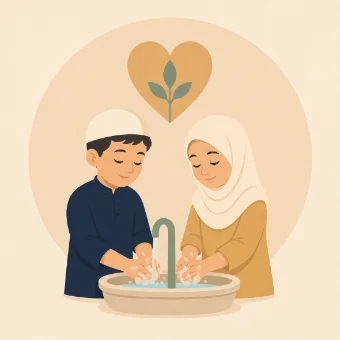
Teaching children about cleanliness in Islam is a gift that supports their worship for years to come. Duha Quran Academy's Cleanliness (Taharah) Course for Kids gives your child a clear, age-appropriate foundation in Islamic cleanliness: how to perform Wudu (ablution), what Ghusl (the full ritual wash) and Istinja (cleaning after using the toilet) mean, and what Taharah (purity) means in daily life.
Lessons are simple, engaging, and taught in live online classes, so hygiene in Islam for kids feels like a natural part of growing up Muslim, not a lecture. Your child learns what to do, why they do it, and how to do it correctly.
 6–9
This course covers the essentials of Taharah in a structured, step-by-step way that young learners can follow.Starting from the meaning of Taharah in Islam, children move through the rules of Wudu, the conditions and method of Ghusl, the correct way to perform Istinja, and the difference between physical cleanliness and ritual purity.
Classes are live and one-on-one. Your tutor works from a diagnostic assessment of your recitation and builds a personal plan around your actual weaknesses — not a generic lesson order.
Parents choose Duha Quran Academy's Cleanliness (Taharah) Course for Kids because it is the only online course built specifically around how children actually learn, through repetition, clear visual demonstration, and an encouraging teacher who never makes a child feel embarrassed for asking a question.
Every teacher on this course is trained to teach children and explains Wudu, Ghusl, and Istinja in simple, respectful language.
Your child learns directly with their teacher, and each session is adapted to your child's pace, age, and existing knowledge.
The course is suitable for children aged 5 to 12, with different language, examples, and pacing for younger and older learners. A five-year-old learns the steps of Wudu through demonstration, while a ten-year-old learns the same steps alongside the Fiqh reasoning behind each one.
Sessions are available throughout the week, in the mornings and evenings, so the course can fit around school and family life.
After every module, parents receive a clear summary of what their child has mastered and what still needs practice.
Children often have questions about Islamic cleanliness that they feel shy to ask in a group. In a private one-to-one class, a patient teacher answers them with care, and parents are welcome to sit in.
One free trial class shows you more than a page of promises — bring a passage and leave with real corrections.
Book Free TrialThe course has four focused modules, each building on the last. Your child learns the reason behind each act of Taharah, not only the steps, which helps the habit last.
Children begin by learning what the word Taharah means in Arabic and why Allah loves cleanliness. This module introduces two kinds of purity: physical cleanliness (keeping clean from impurities) and ritual purity (the state needed for acts like Salah). Simple stories and everyday examples help children see that keeping clean is not only a health habit but an act of worship. By the end, your child understands that cleanliness in Islam for kids goes beyond washing hands before eating.
This module walks children through each step of Wudu in order, covering the obligatory (Fard) and Sunnah actions, the things that break Wudu, and common mistakes children make without realising. Teachers demonstrate with visual aids and short, repeated practice so the sequence becomes familiar. Children also learn the intention (Niyyah) and the dua before and after Wudu. By the end, your child can perform Wudu independently and in the correct order.
This module explains, in simple and respectful language and at a level suited to the child's age, when Ghusl is required, how it is performed, and what makes it valid. Children also learn Istinja (cleaning oneself after using the toilet) and the etiquette of entering and leaving the bathroom. These topics are explained verbally, in a matter-of-fact way that answers children's natural questions without awkwardness.
The final module ties everything together, showing how cleanliness fits into the daily routine: before Salah, after sleeping, before touching the Quran, and washing hands before meals. Children review the rulings from earlier modules, practise real decisions (when is Wudu broken? when is Ghusl needed?), and complete a short assessment so you can see what your child has understood. Each child finishes with a personalised recap from their teacher.
Every outcome below is something your child can demonstrate, not just recite. By the end of the course, you can expect your child to approach Salah, bathroom etiquette, and daily hygiene with clearer knowledge and steadier habits.
Your child can make a complete Wudu in the right order, with the intention (Niyyah) and the dua before and after, without being prompted.
Know When Wudu Is Broken: Your child can name the things that break Wudu and decide whether their Wudu is still valid, so they know when to renew it before praying or touching the Quran.
At a level suited to their age, your child understands the situations that require Ghusl and the steps to perform it correctly, so the knowledge is in place before puberty.
Your child can follow the dua and etiquette of the bathroom and explain the correct method of Istinja, building daily habits of Islamic cleanliness.
Your child can explain in their own words that cleanliness in Islam is an act of worship connected to their relationship with Allah, not only a list of rules.
Your child can describe and follow a simple daily routine: Wudu before Salah, washing hands before meals, and renewing Wudu when needed.
Your child's first live class is free, with no commitment
Real sessions from this course — how tutors explain, listen and correct, one student at a time.
Unscripted words from the people who took the course — recorded after their final class.
Ijazah-holding specialists of the intermediate track — patient correctors, proven teachers.

Quran, Tajweed and Islamic Studies Teacher
View full profile
Quran Teacher | Learning Difficulties Specialist
View full profileMeet the teacher, see the teaching style, and decide with no commitment
Before-and-after journeys from students who started exactly where you are now.
Wherever you are on the path, there is a next step waiting for you.
BeginnerMany children can recite the six articles of faith by name but cannot explain what a single one of them means. This…
View course Beginner
Duha Quran Academy's Angels in Islam Course for Kids teaches belief in angels for kids through age-appropriate lessons, Quranic stories, and guided…
View course Beginner
The Aqeedah Course for Kids at Duha Quran Academy gives your child a clear, structured understanding of Islamic belief — who is…
View courseThe course is designed for children aged 5 to 12. Teachers adapt their language, pace, and examples to the child's specific age and level, so a five-year-old and a ten-year-old both receive an experience that is genuinely right for them.
No prior knowledge is needed. The course begins from the very meaning of Taharah and builds step by step from there. Children who already know the basics will move through the early modules quickly and spend more focused time on the areas where they still need practice.
Each session runs for 30 to 45 minutes — the right length for children to stay focused and retain what they have learned. The full course typically covers [X] sessions, though the pace adjusts to suit each child without any pressure to rush.
Yes. Duha Quran Academy can assign a female teacher for your daughter. Simply mention your preference when you book the free trial class and we will match her accordingly.
Yes. You can pause sessions and resume them whenever your schedule allows. The teacher keeps detailed notes on exactly where your child left off, so there is no repetition or wasted time when you return.
The free trial is a full, live one-on-one session — not a sales call. Your child will actually learn something in that first class, and you will see the teaching style, the teacher's approach, and your child's response before making any decision at all.
Fill in the form — your assigned tutor will contact you within 24 hours to schedule your free trial and level assessment.